Showing posts with label English (A - Drama Reviews). Show all posts

Friday, 6 December 2019

Tuzi Aamri - Marathi play based on Amrita Shergill performed in Mumbai on her birthday - 5.12.2019

The Indian gene of Amrita Sher-gill 

(इसे हिन्दी में पढ़िये - यहाँ क्लिक करके क्र.सं. 6 में देखिए )


Amrita was born in Budapest the capital of a European nation Hungary by a Hungarian a mother who was a opera artist. But her father was Indian Sikh and the inherent gene of her blood was essentially Indian. And this drew her journey in painting from Western to Indian not only geographically but also in terms of style. She got highly influenced by two Tagore brothers of Bengal. It only proves the magic of her Indian origin that though she spoiled herself in a lifestyle much ahead time in terms of indulgence, she portrayed Indian poverty and the condition of village women passionately. Her father was of royal origin and mother too came from affluent European bourgeoisie but she kept immersing in the pains of Indian poverty. Her paternal side had a lineage of British loyalty but her musing was reverberated with the thoughts of Gandhi and freedom struggle. She had also been in intimate friendly terms with Jawahar Lal Nehru and exchanged several letters with him. Both met at quite some occasions and cherished some soft feelings for each others.

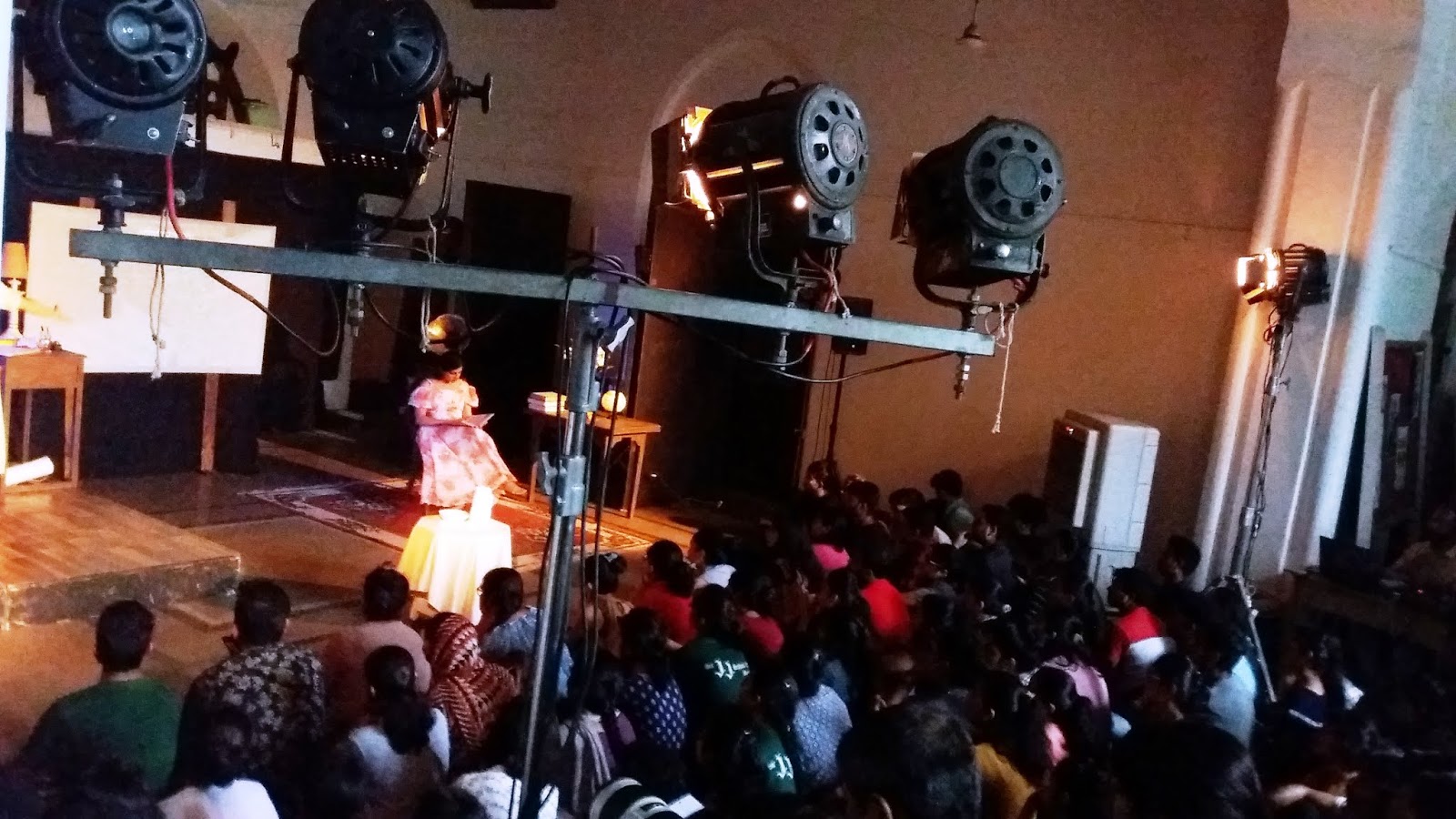
The play performed was actually a discourse on evolution of Amrita's art. She and her sister Indira were shown illustrating the paintings made by her. The paintings included Self portraits, Hungarian Gypsy, Village Young Girls, The Sleep (a nude beautiful young woman in sleep), village women, It was not an action play but was a sort of story telling on Amrita Shergill's internal being, challenges faced within family and in open society.  There were only two artists who delivered their long dialogues faultlessly and with proper emphasis on the words. In the last scene Amrita Sher-Gill is seen dying only at the age of 28 probably because of failed abortion. It is noteworthy that she had gone through abortions many times before her marriage too.

The light was kept dim throughout the play to keep the paintings appearing on the screen in the background quite visible. The sound system worked well and there was absolutely no issue in hearing the dialogues. The actresses kept changing their costumes that displayed the beautiful dresses that could have been in vogue at that period of time. And from that angle it was a feast for the student of fashion designing. 

(The info given below is based on the facebook post of Sri Rawindra Das, a renowned painter and art critique. Click here)

If we look at history of world art, the role of women is negligible in the art world. but on the contrary, Indian art history cannot be written without Amrita Shergill of India. On 5 December at 2:00 pm, the auspicious occasion of Amrita Sher Gill's birthday she was remembered in whole of India but in the best manner in Mumbai. On that occasion a Marathi play "Tujhi Aamri" based on Amrita Shergill, created by Maharashtra Cultural Center and organized by Sir JJ School of Art On being  l Visit Of was performed at Sir JJ School of Art, Mumbai (Fine Arts Department)

Artist: Amrita Patwardhan, Richa Apte
Music: Chaitanya Adarkar
Backstage: Raj
Prakash: Prafulla Dixit
Costumes: Vaishali Oak
Color: Ashish Deshpande
Production system: Harshad Rajpath
Theatrical: Shekhar Naik
Artist: Amrita Patwardhan, Richa Apte
Anchor: Shubhangi
Music: Chaitanya Horizontal
Background: Raj Sandra
Publisher: Prafulla Dixit
Dress: Vaishali Oak
Copyright: Ashish Deshpande
Construction System: Harshad Pathak
........

Report by - Hemant Das 'Him' / Rawindra Das
Photographs by - Bejod India blog
Send your feedback to - editorbejodindia@gmail.com


Thursday, 28 November 2019

Marathi play "Hyān̄caṁ karāyacaṁ kāyaṁ" (I need to do this) staged in Mumbai on 22.11.2019

A house haunted by history
A Drama Review of  ह्यांचं करायचं काय 

(View it after every 12 hrs - FB+ Today Bejod India)


A staff of some don type builder come to an old bungalow. As the people think this old building is haunted one so the owner old couple is facing difficulties in selling this property who also want to go abroad to their child. 

As the boss i.e. the builders don has threatened his agent of killing him if he returns without concluding the deal with the owners of the bungalow, the poor young man bears all the tantrums, idiosyncrasies of the old couple. The story is flexible enough to let various pieces of bizarre drama be shown in different episodes. In  one instance the house lady becomes Jhansi Ki Rani but forgets the dialogues and somehow establishes herself as the Rani of Vashi. In another there is an Akabar and Anarkali in full rage. The comedy reaches its peak when the property mafia's male henchman is treated as 'Salim' to whom the male house owner (Anarkali) wants to marry and of course the owner's wife is a spoiler in this quaint love though not as a wife but in garb of Akabar who is trying to rein in his prince "Salim'

The audience was rolling in the aisles almost invariably after every couple of dialogues. It was only in the last 5  seconds when the play runs at a serious note. 

Undoubtedly the script of Vishal Kadam is the height of witticism, one grievance remains. After all, why he has to take a character of non-Marathi for the only villain. 

The comedy has been created by doctored historic mismatches and calculated misfits of characters. Like the role of Akabar is played by woman (the wife in the owner couple) and Salim is actually a man who is no one than the builder's agent. The house owner husband is almost forced to play Anarkali. This scene is so funny that the viewers were seen struggling with their own sober identity. The laughter was irresistible. It was not suppressible chuckles, it was simply a humour frenzy. 

Paddy Kamble, Vishakha Subhedar and Samir Chaughule were the only three actors who created uproarious scenes of extreme comedy. If we assess them it is undoubtedly Vishakha who not only have extra ponds on her body but also have unmatched talent to make every viewer blissful with uproarious laugh. Though the body movement and the punctuated stress in dialogue delivery she puts her own yardstick ahead each time. Though all the three actors were acting with a natural flow which is quite challenging in a comedy show. befitting to seasoned ones her facially expressions were speaking themselves more than the dialogues uttered. 

Music by Ajit Parab added value and was enchanting but the costumes by  Mangal Kenkare was really vital in the success of this historic comedy. The writer is Vishal Kadam who has not merely experimented  with comedy of errors but moulded successfully the political and social rhetoric of past into the present.
                                                                                    
Rajesh Deshpande as a director has ensured among other matters that the fast tempo of the play is maintained from the  the very beginning till the end.

The play was staged at Shivaji Madir, Dadar (Mumbai) on 22.11.2019.
(The reviewer has just started learning Marathi and does not know this language so there might be error in story part of the review)
....

Review by - Hemant Das 'Him'
Send your feedback to - editorbejodindia@gmail.com
Note- Members of the drama group are requested to send the pictures of the drama on the above email ID. 


Saturday, 19 October 2019

Abhedya staged 'Javeda' on 16.10.2019 at Prabhadevi (Mumbai)

The sinless lovers

 (इस समीक्षा को हिंदी में पढ़िए - यहाँ क्लिक कीजिए / View it after every 12 hrs - FB+ Today Bejod India)


What a farce? Our society thinks murders in communal riots as normal and love of a man with another as abnormal! 

In an emotive discourse, the young man expresses his inability to marry the fiancee and asks her whether his love for another person is proper particularly when that person also happens to be a man?

The reviewer is not championing the theme of the play yet he thinks that no subject should be taboo for discussion. Sure, we must promote normal kind of human relationships, but we have no right to stigmatise the other ones until and unless they harm the society. At least they are much better a lot than a riotous person.

Love knows no boundary - neither geographical nor racial nor of body. A fervent love can exist anywhere between man and woman, woman and woman and "between man and man". You may find it irksome but this is the reality of the society. These have been practiced since ages and would be practised till the world ends. Better we should assimilate them honoring their privacy. The unconventional and yet highly touching story was shown in the play "Javeda' at Ravindr4a Natya Mandir, Prabhadevi (mumbai) on 16.10.2019.

In the beginning, Iman who is a struggler bollywood lyricist reads a newspaper ad for vacant house and knocks at the door of Aman Awasthi. Aman thinks him as a well-behaved and trustful man and agrees to share a part of his house to him for rent.  Aman is dependent on Iman for certain domestic and Iman on Aman for others. Both begin to enjoy the company of other. They soon develop appreciation for each other quite normally.

Iman keeps he the house tidy and prepares tea for Aman. On the other hand, Aman has given one set of the keys of the whole house to Iman so that he has a right to live in the house even in the absence of Aman.

With passage of time, the love between Arman and Iman well surpasses the social realm and enters the cell of individual privacy. Aman is extremely uncomfortable on reading the letter given by the postman that the parents of Iman has fixed his marriage with a girl in the village. Yet, on the pretext of danger of communal riots, he pushes him forcibly to the village so that his normal conjugal relation with a girl could be established.

In the village, Iman meets his fiancee who is also his childhood friend and whom he still likes. He does not want to play cheat on her and reveals the unsavory truth. The truth that he can not marry her because he loves another one who happens to be a man (and not a woman). 

After some time, he cannot bear the separation from Aman and comes back to his house in Mumbai. But their lives together does not last longer and Aman is killed by the mob in a communal riot leaving Aman with no reason to live.

It is more than obvious that neither of two are promiscuous, lascivious or innately different from other men. Though the circumstances make them so. This is proved by the incident when one of the pimp suggests to provide girls to Iman for money who is genuinely in search of an abode. Iman subs him saying that he is not a man of that sort.  Here Aman also has never been in sexual relation with anyone before or after the relation with Iman. Even these two men goes hardly beyond kissing as shown on stage. The whole issue is predominantly a psychological one rather than that of body.

The small details have been knit together so beautifully that they make a sterling show of real life journey of both.  Aman is in such a deep love with Iman that he does not mind even when Iman puts salt in place of sugar. Also, after the departure of Iman from his house, he misses him so much that he stops dringking tea in his office and replaces it with coffee which he never liked. And when Iman returns to his house, Aman again switches over to his old favoured beverage of tea. The tea-seller is totally confused what has happened to Aman Saheb? Even the sweeper, milkman and akhbaarwaalah has to face the ire of this separated touchy lover. 

The actors were Aaryan Deshpande, Ahan Nirban,  Yashaswee Gandhi,  Rinila Debnath,  Akash Soni, Gorande Katira, Katha Salla,  Saundarya Goyal,  Neer Mota,  Pratik Tiwari, Yash Dattani, Anirudh Kolarkar, Pratik Bhadekar and the director-playwright was Navaldeep Singh. It was produced by Abhedya Artworks. The Set-design had been prepared by Pratik Bhadekar & Shubham Jadhav. Sound Desinn was by Navaldeeep Singh only.

The honesty with which the playwright has put the matters is astounding. The playwright Nawaldleep Singh has used the scenes of communal riots deftly to show the striking anomalies in the social psyche. The psyche that permits ghastly murders of people from other community but thinks a love between them a heinous crime.

Among actors Iman's facial expression was really moving. Aman provided adequate support. The two girls who played the alter ego of Aman and Iman respectively did justice to their roles. The comedian villager who wants to marry the fiancee of Iman won the hearts of audience with his queer mannerism. The tea-preparer was able to convey the confusion well with his facial expression and body language. He is confused why sometimes Aman prefers tea and sometimes don't. The sweeper and postman had short role but they played well. The fiancee showed the dignity of the character in true spirit. All the actors were below 25 and performed beyond what could be expected of them.

The set-design with doorstep in the middle of the backstage and couple of chairs and table put on the opposite halves of the stage with lot of walking space helped in seamless toggle between the riotous scene and the inside view of a common household.

The director Nawaldeep Singh has succeeded to keep dramatic effects quite far from this play which was a necessary requirement for an honest discourse on such a serious issue.  He has done an experiment in the form by presenting two females for respective alter egos  of two male characters probably to convey that gender has no role to play in a game of love. But delivery of the endless masculine dialogues from the mouths of two conversing females has it's own risk. 

I have no qualms about saying that it was a brilliant show for restoring the dignity of genuine class of lovers that is regarded unjustifiably as the taboo-est of taboos by our hypocritical society.
.....

Review by - Hemant Das 'Him'
Photographs by - Abhedya and Bejod India blog
Send your feedback to - editorbejodindia@yahoo.com
Read 81 more Drama Reviews by the same author - click here