Tuesday, 21 February 2023

लेख्य मंजूषा द्वारा ब्लॉगर हेमन्त दास 'हिम' के सम्मान में आकस्मिक गोष्ठी पटना में 19.2.2023 को सम्पन्न

 "क्या आज भी लोग रो लेते है, बिना माईक और कैमरा के? .."
(कवि-गोष्ठी की रपट)


"गजल यह है, हम जिस भाव से यहाँ उपस्थिति हुए हैं बाकी तो जो शे'र अश'आर है सो है" 
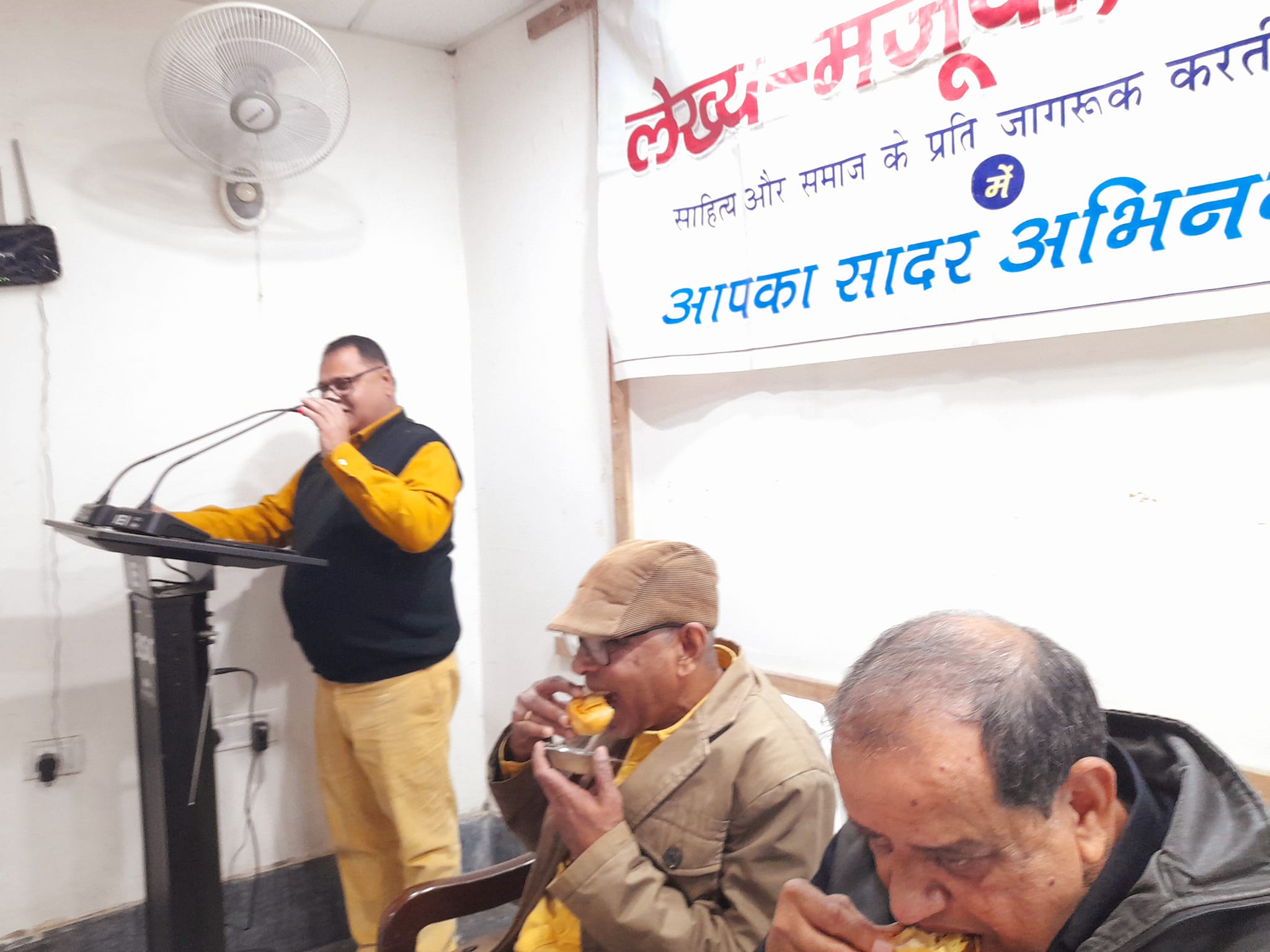
ऐसा राष्ट्रीय स्तर के ख्यातिलब्ध गजलकार संजय कुमार कुंदन ने कहा। रविवार/19 फरवरी 2023 अपराह्न ढ़ाई बजे से साहित्यकार हेमन्त दास 'हिम' के सम्मान में लेख्य-मंजूषा  (साहित्य और समाज के प्रति जागरूक करती संस्था) के द्वारा द इंस्टिट्यूट ऑफ इंजीनियर्स में अनेक सुधी साहित्यकार एकत्र हुए. इस अवसर पर उनके "बिहारी धमाका" एवं "बेजोड़ इंडिया" ब्लॉग के माध्यम से सभी साहित्यकारों और रंगकर्मियों को उत्साहित रखने के सराहनीय प्रयास की सामूहिक रूप से प्रशंसा की गई. 

इस अवसर पर एक कवि-गोष्ठी का आयोजन भी हुआ. मुंबई से गृहनगर पटना आए हेमंत दास 'हिम' की अध्यक्षता में हुई इस गोष्ठी में उनकी कविताओं जैसे "क्या श्रेष्ठ बाजारवादियों के इस युग में / अब भी उपलब्ध है कोई  फटा रूमाल..." और "क्या आज भी लोग रो लेते है / बिना माइक और कैमरा के..." जैसी पंक्तियों ने श्रोताओं को सोचने पर मजबूर कर दिया.

आकस्मिक रखी गई गोष्ठी में राष्ट्रीय स्तर के प्रतिष्ठित शायर संजय कुमार कुंदन के अलावा लेख्य-मंजूषा के उपाध्यक्ष एवं बेहतरीन कवि मधुरेश शरण, उर्दू-हिंदी शायरी में ऊचा मुकाम हासिल कर चुके सुनील कुमार, संवेदनशील कविगण कृष्ण समिद्ध, कमल किशोर वर्मा, डॉ. मीना परिहार एवं डॉ पूनम देवा, नूतन सिन्हा, ऋचा वर्मा, रंजना सिह, पूनम (कतरियार) तथा डॉ. प्रतिभा रानी की सम्मानीय उपस्थिति रही। आगंतुक युवा कवियों में अमृतेश मिश्रा, अनिकेत पाठक एवं  ने भी अपनी रचनाओं का पाठ किया। सम्पूर्ण आयोजन में लेख्य-मंजूषा की अध्यक्षा विभारानी श्रीवास्तव की केंद्रीय भूमिका रही.

शायर सुनील कुमार ने अपेन प्रभावकारी संचालन द्वारा सब को बांधे रखा. धन्यवाद ज्ञापन मधुरेश नारायण और संस्था की अध्यक्षा विभारानी श्रीवास्तव ने किया. अल्प सूचना पर आयोजित हुए इस कार्यक्रम में कविताओं तथा गज़लों की अविरल रसधार बही।

अज़ीम शायर संजय कुमार कुंदन ने ख़ूबसूरत शायरी का नुस्खा दिया -
"आरजू गर लहू नहीं होती
शायरी ख़ूबरू नहीं होती
अब न कोई कलाम कोई सुखन
ख़ुद से भी गुफ़्तगू नहीं होती
तीरगी का भी एहतराम करो
रौशनी चार सू नहीं होती
तेरी वहशत में मैं नहीं होता
मेरी ख़्वाहिश में तू नहीं होती
कैसे फेरे में पड़ गया 'कुन्दन'
संग से गुफ़्तगू नहीं होती.."
(ख़ूबरू= सुंदर चेहरे वाला, तीरगी= अंधेरा, एहतराम = सम्मान,  वहशत= उन्माद, संग= पत्थर)

डॉ मीना कुमारी परिहार ने अपने मधुर कंठ से स्वरचित रचना का लयबद्ध गायन कर श्रोताओं को मंत्रमुग्ध कर दिया. उनकी पंक्तियों में बढ़ रही संवेदनहीनता पर कड़ा प्रहार भी था -
"गले भी लगाएं वो और प्यार भी करें
ये आदमी नहीं है इक जात है नई
अक्सर ही लोग जाते हैं छोड़ कर मुझे
तुम भी चले जाओगे, क्या बात है नई.."

डॉ. प्रतिभा रानी ने लोगों के हारते मन में हौसला भरा -
"हे मन, क्यों घबराता है
क्या कोई किसी के काम आता है?
जीत वहीं होती है
जहाँ प्रयास होता है.."

भावप्रवण कवि मधुरेश नारायण ने अपनी पंक्तियों से प्रेम की बरसात कर दी -
"चुपके से कोई मेरे जीवन में 
प्यार के रंग घोल दे
कोई आकर मेरे कानों में 
प्यार के दो बोल, बोल दे.."

लोकप्रिय शायर सुनील कुमार आसमान नापते दिखे -
"चर्चा अब क्यूँ थकान पर करिए
हौसले से उड़ान है प्यारे
हम परिंदे हैं, नाप लेते हैं
मुट्ठी में आसमान है प्यारे.."
उन्होंने कार्यालय के अनुभव पर भी एक सुंदर रचना पढ़ी जो कुछ यूँ थी- 
"तमाम लोग जो अक्सर इधर उधर में रहे
वो सारी जद्दोजहद करके भी अधर में रहे.."

अमृतेश कुमार मिश्रा ने अपनी ग़ज़ल से सब का दिल जीत लिया - 
"हमारी ज़िंदगी में तुम नहीं हो
हमारे दिल में अब धड़कन नहीं है
मेरी पेशानी को चूमा है जबसे
मेरी दुश्मन से भी अनबन नहीं है
घुटन की बात पर इतना कहूँगा
मुहब्बत योग है  बंधन नहीं है
किसी के ताज पे सोना मढ़ा है
किसी के जिस्म पे कतरन नहीं है.."

कवयित्री ऋचा वर्मा ने भोग- विलास में लीन, सीमा पर जान की बाजी लगा रहे और आतंकवाद की ओर उन्मुख हो रहे तीनों प्रकार के पुत्रों को उनकी माता की याद दिलाते हुए सच्ची वीरता और देशभक्ति को अपनाने की सीख दी - 
क्या आएगा उसका पूत ?
जीवन की रंगीनियों को तज कर, 
सरहद पर दुश्मनों को मात देकर, 
या, अपनी मातृभूमि को लहुलुहान करने के इरादे को तिलांजलि देकर
शायद . हां, नहीं, जरुर आएगा
क्योंकि 'मां' की दुआएं कभी खाली नहीं जाती.."

पूनम कतरियार ने स्त्री के अस्तित्व पर कहा - 
"अमृत-प्रवाह हूं,
बहने दो मुझे.
ऊंचाई ने दिया आवेग,
प्रस्तर-खंडो ने संघर्ष दिया.
टेढ़े-मेढ़े राह-बाट में,
खर-पतवार भी,खूब  मिलें.
भूख -प्यास से बेहाल,
बांझिन-रेत मिलीं,
तरसती-धरा का क्षोभ दिखा..."

कुछ वीर-रस के कवि भी क्रोध का औचित्यीकरण प्रस्तुत करते हुए साहित्यिक गुणों से परिपूर्ण वीर-रस पर अपनी रचनाएँ पढीं - 
अनिकेत पाठक ने परशुराम जी के क्रोध को दर्शाते हुए कविताएँ पढीं - 
"यदि न्याय न दिला पाए 
तो किस काम का तेरा बल?.."
कवि कमल किशोर ने भी क्रोध को उचित ठहराया - 
"संंधि-प्रस्ताव जब निरस्त हुआ 
कब तक अन्याय सहा जाए?
क्यों नहीं क्रोध किया जाए?.."
इन कवियों की रचनाएँ काफी प्रभावकारी थीं, यहाँ यह कह देना प्रासंगिक होगा कि आधुनिक काल में क्रोध के व्यक्तिकरण का स्वरूप बदल गया है. अन्याय और अत्याचार का कठोर दमन होना ही चाहिए किंतु आधुनिक समय में यह काम सर्वसाधारण जनता का नहीं अपितु सैन्य-बल और पुलिस बल का है. जनता का काम अन्याय और अत्याचार के दमन में उनका सहयोग करना है स्वयं कानून अपने हाथ में लेना नहीं. 

कवि कृष्ण समिद्ध ने कविता नहीं पढ़ी. उन्होंने कहा कि हेमंत जी को मैं ने पहली बार "दूसरा शनिवार" की काव्य गोष्ठी में देखा था. किस गंभीरता से आप पटना कविता और नाटक जगत में आप रहते थे और अपनी कलम से अपने नोट बुक पर हर घटने वाली घटना और पंक्ति को दर्ज किया करता थे.

नूतन सिन्हा ने प्रकृति-प्रेम को चित्रित किया -
"रात्रि के प्यार में 
दिवा रहता है दीवाना.."

अंत में कार्यक्रम की अध्यक्षता कर रहे हेमन्त दास 'हिम' ने अपने विचार रखे. उन्होंने कहा कि कविता में बुराइयों का विरोध होता है किंतु इसका अर्थ यह नहीं है कि वह किसी खास राजनीतिक या सामाजिक समूह के खिलाफ है. दर-असल बुराइयाँ हर जगह, हर समूह और हर व्यक्ति में है,  स्वयं उस रचना को लिखनेवाले में भी. अत: कविता सब के साथ-साथ स्वयं उसकी रचना करनेवाले कवि के भी खिलाफ होती है. स्पष्ट है कि कविता में विरोध की अभिव्यक्ति का कभी बुरा नहीं माना जाना चाहिए. उनकी कविता की कुछ पंक्तियाँ इस प्रकार थीं - 
"क्या श्रेष्ठ बाजारवादियों के इस युग में
अब भी उपलब्ध है कोई फटा रुमाल
उन गीली आंखों को
जिन्हें पोछने वाला कोई भी नहीं? "

 प्रख्यात शायर संजय कुमार कुंदन जी के बारे में हेमन्त 'हिम' ने कहा कि उनके समक्ष किसी और का सम्मान बेमानी है. साथ ही उन्होंने यह भी कहा कि यह सत्य है कि उनके पटना छोड़ने के कारण वे स्वयं और पटना के साहित्यिक मित्र एक-दूसरे की कमी को महसूस कर रहे हैं और एकत्र होने के लिए यह बहाना अच्छा था. उन्होंने मौजूद कवि-कवयित्रियों के साथ वर्ष 2019 ई. तक (जब तक पटना में रहे) के संस्मरणों को याद करते हुए लोगों की बातों में हामी भरी कि किस तरह उनके द्वारा रात-रात भर जग कर पटना की लगभग हर गोष्ठी की रपट वर्षों तक प्रकाशित होती रही. उन्होंने मक़बूल शायर सुनील कुमार और उत्तम कवि मधुरेश शरण, कृष्ण समिद्ध समेत, भावप्रवण कवयित्रियों पूनम कटरियार, ऋचा वर्मा, मीना परिहार से अपने ऑनलाइन संवादों को याद किया और आज आमने-सामने होने पर खुशी व्यक्त की. 

कार्यक्रम में संस्था द्वारा पुरस्कृत कवयित्री ऋचा वर्मा को पुरस्कार स्वरूप अनिरुद्ध प्रसाद 'विमल' लिखित प्रबंध काव्य 'कृष्ण' को हेमन्त दास 'हिम', संजय कु. कुंदन और मधुरेश शरण के हाथों प्रदान किया गया.
.....
रपट - पूनम (कतरियार)/ बेजोड़ इंडिया संचालक मंडल
अपनी प्रतिक्रिया भेजिए ईमेल से - editorbejodindia@gmail.com
सभी हिंदी पोस्टों को देखने के लिए संभाग डी (D) पर जाइये - यहाँ क्लिक कीजिए


Tuesday, 14 February 2023

"Dark days & white nights" in Hindi staged at Creative Adda, Versova (Mumbai) on 11.02.2023

 A cast of new societal re-make
(Drama-review)

हिंदी में समीक्षा के लिए -  यहाँ क्लिक करके क्रम सं. 10 देखिए 

Someone is mocking at someone, someone pepping up, someone to wage a war, someone to pacify, someone protruding in other's privacy, someone getting emotional on petty issues. These seemingly unrelated issues are beautifully threaded with a love saga that eventually turns the improvisation into a script. Each piece of activity is a miniature form of a social phenomenon. Showcasing all this was the play “Dark days & white nights” directed by Mr. Sarfaraz under the  production of "The Crafters Acting school". It was presented at Creative Adda, Aram Nagar, Versova (Mumbai) on 11.02.2023.

Let us begin with the love-line. A nice-looking girl is admitted in a higher secondary school where everyone else is a brat. She gets frightened by the undue advancements of the boys except the one who forms a wall to save her. Not in a Bollywood style she fails to fall in deep love for the saviour boy and just accepts him as a good friend. Though the condition of the saviour is different and very delicate. In spite of losing his heart completely for her, he willingly cooperate in her pursuit of the old flame.

All students have a high regard for their excellent biology teacher Mr. Mike. But at the same time, they are also relishing in the gossips of the fledgling romance between him and Kalpana Ma'am. They are always there to scoop Mike and Kalpana. And the limit is transgressed  by one of the boys when he posts on the Instagram in Hindi which virtually means that Mike is using Kalpana for his gratification. On this, Miss Kalpana is so annoyed that she plans to leave the city and so does Mike. Now the students suffer in repentance. They leave that fellow alone who admits his guilt.

Each of the students carry the sweetness or sourness of the conjugal relationship of their parents as a legacy. The absence of father or mother is but obvious in the personality of some ill fated ones and they are looked down upon by others for their shortcoming that was not in their hands.

The communal string also forms one of the motifs of the presentation. While participating in the gossips on Mike-Kalpana, one of the students blames another with the vilest remark "tumhare wale me se hain to tum to support karoge hi". This leaves the victim in black despair but somehow other sensible guys pacifies the situation.

A big tragedy stuns everyone. As soon as the bout of one-sided love of the saviour boy for the girl reaches a point where she is about to show the green signal, the sudden appearance of her old love changes the scene again and she goes with her dropping the saviour guy. When this ill-starred soul shares his hurt feelings to his bosom friend hoping some consolation, he advises him to commit suicide. On this, he takes the poison bottle from the pocket of his  sleeping drunkard friend and pours it under his throat. After shivering for a while, he seems to be lifeless. But he is not, in fact the poison-bottle waved by the boy was just a hoax and it was not poison. But a deep gloom envelops the whole atmosphere when it is known that the boy who suggested the saviour boy to commit suicide himself committed suicide. Actually he was feeling too lonely because of tense conjugal relationship of his parents. He was not among others who was sent to this residential school by choice of parents but he was the only one who himself had preferred to live away from his parents.

Ultimately it comes out that the peaceful or hostile nature of the conjugal relationship between couples is vital for the re-building of a healthy society. The other message comes over the surface is that it all depends upon the guide who can make or mar the society. 

As already mentioned, the script was not a traditional type one and it has been spontaneously improvised by the students with some modulation by the director. And both students and the director have done their jobs deftly to make the bunch of thoughts presentable and meaningful. Barring the God Buddha analogy, everything suited the theme of the play. The students in different roles acted well and the whole idea of the director was superb.
.....

Review by- Hemant Das 'Him'
Send your response to - editorbejodindia@gmail.com / hemantdas2001@gmail.com
For seeing all Drama Reviews - Click here


Tuesday, 7 February 2023

"Pankh hote to udd jaati re"-a Hindi play staged on 04.01.2023 at Versova (Mumbai)

 Fling off with your wings
(Drama-review)

हिंदी में समीक्षा के लिए -   यहाँ क्लिक करके क्रम सं. 9 देखिए 


There is no poetic justice in life but justice to your life is surely in your hand.

When God prefers to look awry to a family that is already stung by poverty then this is called the acme of narrow circumstances.  The mother in a noteless village has a sole concern.  She has a marriageable daughter who stumbles in walking. Encumbered with her parental duty of getting her daughter married she has a drunkard son who is hardly someone she could look for help.

The family has only three members, all living their life as if in a limbo lane. The son Pratap is a night-roamer but somehow attends his workplace in daytime.  The handicapped daughter Sukni is a day-dreamer. The mother seems to be a totally responsible woman but both of the children irresponsible ones. In real, all the three are innocent ones having good human hearts. The per month income of the mother and son are Rs.400 and Rs. 600 respectively, too low. And even the domestic condition being in dire straits, the daughter Sukni prefers to converse with innumerable different avian creatures on the top of a manless hillock skipping her classes of carpet-art.

Consistently pestered by the nagging mother, the son calls her a witch and from that time both of them are not on talking terms. 

One day Pratap sees her limping sister falls on the floor. He rushes to help her. And just at the nick of hour, the sister takes a vow from him that he will go to talk with his mother asking for forgiveness. And when he does so, the mother is not far behind in taking a promise from him that he would not drink any more. He vouches to become a teetotaller. But the story does not end here.

The main problem still looms large as how to marry off the daughter. For this, Pratap brings his school-time friend Nirmal to his home. He is the same guy whom once Sukni loved while studying in the school. In just an hour of stay, Pratap is enamoured by the pristine beauty of Sukni. Both hug each other and it looks that they have fallen in love but suddenly Pratap steps back and conveys that he is already engaged with some other girl who is now her fiancee. For a moment, Sukni is broken but without any delay she declares that she is now feeling charged up and she also has no need to take support from someone else. She will take up all challenges in her life on her own.

The Hindi adaptation of Tennessee Williams` play "The Glass Menagerie" was done by Vijay Raj and Gajraj Rao. The play was directed by Manoj Verma. The play as presented by the actors was truly loyal to the spirit of the story. The characters of Mother, Son, Sukni, Pratap etc. were lived up by (names not in order) Surya Mohan Arya, Kanchan Tendulkar, Roshan Kumar Singh and Priyal Chandel. Music inputs from Priyadarshan Pathak, lyrics by Pankaj Tyaagi, lights by Devendra Mistry and the choreography by Kanchan Tendulkar added their significant parts to the presentation.

The interactions of three disgruntled souls formed the motif of two-third of the play and it was so realistic that any of the audience could connect with. The firebrand son Pratap truly impressed the audience as an angry young man and the mother appeared on the stage as if a magic mix of frustration and affection. 

The choreography hinged mainly upon the sole dance bites of Sukni with some sporadic scenes of group dance. The icing on the cake was the meaningful mellifluous sweet songs sung by Sukni and Nirmal. They had the capacity of energising every sort of aspiring individuals. The set-design gave a true experience of lower-middle class home. Though in my view, the window could have given some view of the mountains suiting the tenor of the script. This could have been possible by putting a scenic picture outside of the window beyond the passage which perhaps also consisted a part of the visible stage area. 

In this Ambrosia Theatre group presentation, the director has definitely succeeded in bringing out the best of acting skills from the proclaimed neophyte actors. The back-stage crew specially on lights and sounds contributed their portion in the superb delivery of the play.

The play left a long-lasting happy memory to the viewers.
......

Review by - Hemant Das 'Him'
Send your response to - editorbejodindia@gmail.com / hemantdas2001@gmail.com
(Note: More photographs can be added if sent by the drama-team.)

For seeing all Drama Reviews - Click here


Sunday, 1 January 2023

"Thanks Dear" - a Marathi play staged at Dadar (Mumbai) on 31.12.2022

 The Real Guru 
(Drama review)

हिंदी में समीक्षा के लिए -  यहाँ क्लिक करके क्रम सं. 8 देखिए 


No virtuoso worth your guru-dom except yourself. The thespian line is too parched! The field of acting which invokes emotions and ideals in endless masses is itself eroded of all of those. The Marathi play "Thanks dear" is a nonchalant discourse on the moral conflict invariably faced by all actors.

Raghu is a highly talented actor who is still attempting hard to establish in the film industry. He comes across a girl Sati who doesn't know much about how to act but is diehard adamant on becoming a high-profile actor. Initially Raghu laughs at her and derides her aspirations. But when he is convinced that she is really serious to join the acting profession, he teaches him some lessons. He shares a magic mantra of high-class acting and says that she should deliver a dialogue keeping in view the subsequent unspoken dialogue of the responding actor. See, such unspoken dialogues are never written in the script and are only delivered through the body acting of the responding actor. Sati remembers this as her life- lesson. Raghu shows her the photo of his guru hanging on the wall and says that this grand man is his source of inspiration and bowing down before him enhances his capacity to act marvelously. Sati has a face of disapproval on this. Raghu is furious on the insult of his guru and forces her out. Then for many years he does not have any contact with Sati and keep himself in touch of his guru who keeps blessing him for his success. Then after 3 and half years, Sati again turns up before Raghu and shows her trophy awarded in a prestigious movie competition. At first, Raghu is confused how to react but soon he expresses his pride for the prize won by his acting student. On being asked by Raghu to take blessings of his guru also, Sati reveals a truth about the guru hearing which Raghu is shattered. How the story moves ahead, let me keep silent for it as the play is still making rounds.

I must say that keeping the audience engaged throughout in a hardcore moral discourse that too relying primarily upon the conversation of only two actors must have been a hurculanean task for the writer and director but the strong script and utmost finesse in acting made the boat sail through. One astonishing fact was that even though the whole story relies only and only on the heavy interactions of two unrelated young characters of opposite sex, there is not even a tinge of romanticism in the whole discourse. There is numerous scenes in the bedroom but not a single bedroom scene. There are evidently occasions of drinking bouts but even in the saturation of drunkenness they cling to the main object of the play. They hug, they dance but without any romantic diversion. The dialogues were so witty and realistic that the audience never felt the burden of the unsavory facts they were being enlightened too.

One thing the viewers loved to watch was that whenever the girl was shown the door out she came back jumping  into the window. 

Both the actors were immaculate in dialogue-delivery and body acting. The set-design was impressive and as per the requirement of the story. The female actor was neatly dressed and so was the male. Light and sound effects were good. 

The play was written and directed by Nikhil Ratnaparkhi and Tushar Gaware. The actors were Nikhil Ratnaparkhi and Hemangi Kavi.

This play seemingly shows you a solution to the multi-dimensional thespian dilemma. The issue is so intricate that vistas of debate opens up fiercely once allowed. Though we all know that a play's success lies on the manner it a subject is dealt with and not in the subject itself. So I can say that the play is fully successful in terms of impressing the minds of the viewers along with giving the wholesome entertainment.

Review by - Hemant Das 'Him'
Send your response to - hemantdas2001@gmail.com
For seeing all Drama Reviews - Click here


Sunday, 25 December 2022

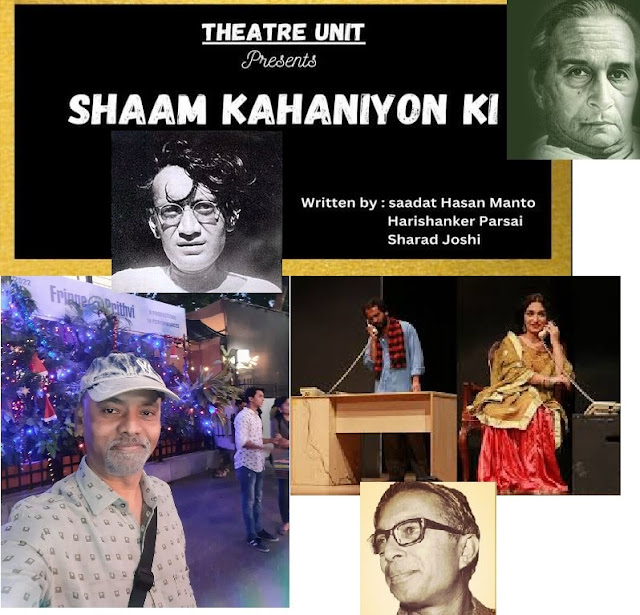
"Sham kahaniyon ki" presented by The Theatre Unit on 24.12.2022 at Pritvi House (Mumbai)

The bite of pretensions
(Drama-review)
हिंदी में समीक्षा के लिए - यहाँ क्लिक कीजिए

The 'biting' trespasses the echelons of the nerves and mind and reaches your soul, questions straight the premise of your existence. You find yourself heavily stirred to reconsider your own 'make'. “Shaam Kahaaniyon Ki” was not just a montage of short stories, it was an all-time quintessence of satires in Hindi-Urdu literature. 

To let you peep into the event, here is a little piece presented there in a semi-acting style. (I am proud to say that the following terse sentences can only be written in the dearest "Hindi' and I challenge, not in any other language in the universe)

...इतने बड़े नेता और ‘ता’ गायब। उन्हें सेक्रेटरी ने बताया कि सर आपका ‘ता’ नहीं मिल रहा। आप सिर्फ ‘ने’ से काम चला रहे हैं। नेता बड़े परेशान। नेता का मतलब होता है, नेतृत्व करने की ताकत। ताकत चली गई, सिर्फ नेतृत्व रह गया। ‘ता’ के साथ ताकत गई। तालियां गईं, जो ‘ता’ के कारण बजती थीं। नेता बहुत चीखे। पर जिसका ‘ता’ चला गया, उस नेता की सुनता कौन है? खूब जांच हुई पर ‘ता’ नहीं मिला। नेता ने एक सेठ से कहा, ‘यार हमारा ‘ता’ गायब है। अपने ताले में से ‘ता’ हमें दे दो।’ सेठ बोला, ‘यह सच है कि ‘ले’ की मुझे जरूरत रहती है, क्योंकि ‘दे’ का तो काम नहीं पड़ता, मगर ताले का ‘ता’ चला जाएगा तो लेकर रखेंगे कहां? सब इनकम टैक्स वाले ले जाएंगे। कभी तालाबंदी करनी पड़ी तो? ऐसे वक्त तू तो मजदूरों का साथ देगा। मुझे ‘ता’ थोड़े -देगा।’ नेता ने सेठ को बहुत समझाया। जब तक नेता रहूंगा, मेरा ‘ता’ आपके ताले का समर्थन करेगा। आप ‘ता’ मुझे दे दें और फिर ‘ले’ आपका। लेते रहिए, मैं कुछ नहीं कहूंगा... (from a story "नेतृत्व की ताकत" by Sharad Joshi)

One-by-one story bolly-firing of humour from a catapult was what was happening there and it was  impossible for a hynotised person like me to count the stories.  I guess it was around ten.

In "Baadshaahat ka khatma" a beautiful young lady makes a blind telephonic call to a man who is a typical pauper living on footpath but have been in access of a telephone just because he has been requested by his friend to sit in the office for some days till he returns to his office. The lady has a honey-coated voice. The pauper man picking up his call loves her voice and have a lot of romantic ideas about her. The surprising fact is the beautiful lady is very much interested in the pauper man and that man there does not even aspire to get her name, address or phone number. He is always indulged in a novel some of whose last pages are torn off and missing. When asked he truly states that this phone is available only till the coming back of his friend who works in this office. Then the lady requests that he should inform just before the arrival of his friend so that she could give her name and address. It is obvious that the lady wants to keep in touch with her distant lover but this man is quite aware of his limitations. The lady informs that she will go to some place for two days and would not be able to make him a call in that period. When she comes back to her home, she decides to give her name and address to the man on telephone so that she should not miss her contact. That man on the other end picks up the call and keeps up his promise by saying that "my kingdom is now going to end" before he dies of his illness. 

The whole story was presented with the utmost poignancy and fully in acting form. The honey-tongued lady actor looked really very beautiful and young and the bearded man on the other side near the telephone was with a novel and a blanket truly giving life to the character. Amazing show!

In another story 'License' by Manto, a charming unmarried girl gets on the 'tonga' to go to  her relatives who are waiting for her a few miles away. The coachman is stung by the beauty of the girl and airs the signals of love. After some initial hesitations the girl too likes the ways of the coachman and both fell in love for each other. She forgets where to get down and goes away with the coachman. The relatives of the girl is flabbergasted and cuts off their connections with the girl. The girl marries the coachman and start living happily together. But after some days, the coachman dies of a disease. In this situation the girl (now coachman's wife) has to take care of the job of driving her 'tonga' for her livelihood. As she is young and beautiful, she never lacks passengers and people ride her tonga just to bring her closer. She notices that people are not interested in going to their destination and just enjoy sitting beside her". Some people stares on her body, some passes obscene comments. The lady bears it all for her livelihood and tries to keep herself habituated with this condition. Day by day, more and more infamy gathers on to her and she is engulfed by the most redoubtable personality in the locality. The matter reaches to the drivers association and they cancels the license of the lady's coachmanship. She meets the executive body of the association, prays to allow her to pursue her profession of tonga-driving. She begs for the mercy. On this, the executive body gives a rebuff and says abusively her to practice prostitution. As the lady does not know anything else and she had to earn for her livelihood, she really became a prostitute from the coming day. The story ends like "... and from the next day she got the license to undergo prostitution."

This story was also presented in a mix of narration and acting. Impressive show!

In another story perhaps by Harishankar Parsai, there are two friends. One friends travels to many kilometers and meets his friends frequently and keeps on his garrulous arguments. He is an epitome of turncoat. He starts putting his arguments in favour of something but just at the nick of the response  of his friends, he begins opposing it. Means, whatever his listener friends likes he will oppose it and the tendency is to such a extreme extent that the listener friend is confused whether he should approve or disprove of the idea of the speaker. It is but obvious that the listener friends has no way but to bears it all. Sometimes the speaker friends is so wild and forceful that he becomes violent on his arguments and gives a blows for favourable or unfavourable responses to him. Then a day comes when the speaker friend fails to get selected for a job. Though he had appeared for it and had answered the questions well still he is not selected because of partiality of the selectors. After failure in the recruitment-exam, the speaker friend is mentally depressed. When the listener friend comes to meet him, he expresses his support for the speaker friends and agrees with his views that the system is corrupt. Surprising he sees that the speaker and listener both have agreed on the point.

The message is that you take every issue as a debatable thing and just a matter of intellectual pleasure till the pinch of it reaches your self. Then you come to senses and understands that it is not just a matter of verbal play but really a serious matter.

In a story "Mr Moinuddin" by Sadat Hasan Manto, a socialite wife of a rich person is his darling lady. He is blind in his love to such an extent that he does not mind if she dances with other men also in parties of the clubs. He believes it is a sign of modern fashion bourgeois culture. One day, the wife says Moinuddin that she wants to divorce him and marry other richer man with whom she likes to dance in the clubs. Mr. Moinuddin feels bad but bears it and allows her to live with the other rich man but requests her to live in his house alternatively after duration of some days. This arrangement of living for some days with Mr Moinudding after many days with others would be helpful to maintain the high-status of Mr. Moinuddin in the society as he would be able to proclaim that everything is well in his conjugal life. Some days this merrymaking continues. After some days the richer person and new husband dies because of heart attack. Because of the His all wealth comes under the control of this lady now who is still known as Moinuddin's wife. Now Mr. Moinuddin rejects her and says that now he does not want to live with her even for a single day. He also gives all of his wealth including the house to his corrupt wife and leaves the house. So, now this lady has huge empire of wealth with her but not a single person who loves her or on whom she could trust.

The director Hidayat Sami has done an incredible job. The credit goes to him not just in the manner he was able to extract remarkable job from the boys and girls who are still under training, but also in the selection of these representative stories. He also showed how with very thin mass of set-properties, excellence can be brought in terms of impact on the viewers. Like in "Netritwa Ki Taakat', the whole story is just being narrated by a character and the viewers are engaged the whole way he dresses himself up as a 'Neta' and it is not a chance that the end of dressing up and the story comes at the nick of time.

The actors were Abhineet Choudhary, Nishu Aggrawal, Shivam Yadav, Krupal Raval, Dhrreti Bhatt and Aashitosh Solanki. Their performance was superb in terms of style of dialoogue delivery but in case of some of the male actors, the pronunciation and grammar were a little bit of issues which can be removed just by more and more presentations like this.

The whole show was extremely successful which is evident by the fact that no viewer could get a moment to yawn during the show notwithstanding the fact that the show was more a presentation of Hindi literature than a drama. 
.....
Review by - Hemant Das 'him'
Send your response to - editorbejodindia@gmail.com / hemantdas2001@gmail.com

For seeing all Drama Reviews - Click here

(Note: The scene of the play is of "Baadshahat ka khatma" is from some other show by the some other group at a different place on a different occasion. Though here also the scene was similarly beautiful but photography was not allowed.)


Tuesday, 20 December 2022

"Dil Hai Ashikana" staged by Purvabhyas at Versowa (Mumbai) on 17.12.2022

 Love, love and love
(Drama-review)

हिंदी में समीक्षा के लिए - यहाँ क्लिक कीजिए


It is upon you. Either you go by the wishes of your children on their love matters or be ready to face a catastrophe.

The .story is simple. Makkhan Singh and Malai Devi are respectively from Punjab and Bihar and are happily married to each other. Their daughter Tintin studइies for MBA in a college where she has a classmate Chatkar and both are in love. Since Chatkar is not yet earning, Makkhan is not agree for the marriage of his daughter Tintin with Chatkar. Tintin's mother Malai is sympathetic towards her daughter and makes a plan so as to get Tintin's father (Makkhan) ready for this marriage. Tintin is advised by her mother to act like she has gone in psychopathic stage of deep depression. Then, she consults a drama-artist Bhawara and asks him to disguise as a wedding match-maker. The match-maker Bhanwara brings the lover Chatkar in a different make-up who tries to impress Makkhan. But Makkhan catch hold of his beard and comes to know that he is being cheated. He dares them from this marriage. Here Makkhan's wife Malai intervenes and put forth the point that if the children are not allowed to marry by their choice then they can flee away and also honor killing like situation may arise. On this, Makkhan comes to senses and gives his consent for the marriage. 

There is one more young lady Bulbul as an important cast. She is a beautiful flirtatious domestic help. Mama (brother of Malai) is a character who is hankering for the love from Bulbul and the driver-cum-manager Chirkut is already there who keeps on claiming that Bulbul is his fiancée. Bulbul does not deny this claim but keeps on love-making with all the other boys simultaneously. 

The play is a comedy full of witty dialogues, dance and romance. A wholesome entertainment is what you get. Some chirpy political comments are inserted in the script showing a tinge of ideological inclination of the writer but goes well with the fervour of humour. Producer Prairna Agarwal has herself written the script which consists of numerous frequently chainging tiny shots of scenes. Credit goes to her for keeping the script taut without any slag. Makkhan Singh (Navin Agrawal) was also the director of the play. He and Prairna (Malai Devi) have not merely acted marvelously with perfect facial expressions, body movements and dialogue delivery but also have been able to extract the max potential of the new actors out. 

While Tintin (Neetesh Yadav) has been able to establish herself as a modern diva who is a loyal to her partner too, Bulbul established herself as quite the opposite pole of it. Mama looked truly a loser in love-game and Chirkut impressed with his possessive gesticulations. And last but not the least the Bhanwara stole the hearts with his romantic gestures.

The name of the actors were Navin Agarwal, Prairna Agarwal, Ayush Rastogi, Neetesh Yadav, Akash Mishra, Ritika Vaishnav, Mayank Sharma and Ankur Shukla.

This play is like a relaxing dose for all facing a burdensome life. 
...

Review by - Hemant Das 'Him'
Send your response to - editorbejodindia@gmail.com / hemantdas2001@gmail.com
For seeing all Drama Reviews - Click here


Friday, 9 December 2022

"End Game" - English play staged at Versova (Mumbai) by Odyssey Art on 3.12.2022

 A hollow world of eerie pleasures
(A drama-review)

हिंदी में पढ़ने के लिए - यहाँ क्लिक करके क्रम सं. 7 देखिए 


Each and every thing about this play is full of discomfort and the takeaway is "Life is a saga of absurd banality in the most grotesque form". 

Hey! I truly mean the above statement. But what is more important is that the very objective of this play was to give a feel of disgust to the viewers.  The play written by Samuel Becket and directed by Sonu Pilania belonged to the absurdity genre.

The drama-architecture reflected uneasiness and discomfort in all dimensions of the deliverables right from the sitting arrangement of the viewers, there were no chairs and you had to sit on lengthy wooden blocks. None of the four characters in the play had even traces of charm in look, gait or mannerism. No character showed any love or sympathy for each other though the servant seems to be obedient enough so as to secure his job there.

 Two characters don't have any leg, one has a crippled leg causing consistent problem in walking and on top of this the one who is the main character (you may say) is blind, crippled and his body oozing out the blood slowly as is evident from his red-stained shawl.  And the same condition prevailed throughout the play. I mean the set of discomfiture you see in the beginning is there to remain up to the very last scene and there is no scene even as a flash-back without the aforesaid discomfiture. The pet-dog which the wheel-chaired man (main character) asks to get him is in fact a stuffed toy without a leg. The mother and father of the wheel-chaired man are kept  in two separate dustbins and though after lapse of considerable time, they pop out their heads and converse to each other but are not able to kiss each other because of physical separation. The servant has an obscure sexual identity as he is seen worn with feminine attires but is in fact is a man. When the master (the wheel-chaired man) asks him to help him sit properly in a central position, the servant retorts that he is unable to touch him. Rather he moves the wheel-chair round the room so that the master may feel that he is sitting in a proper posture.

During the whole duration of the play, none came in and no one went out from the room. Nothing specific took place other than some of the hot conversation on trifle matters.

The typical display of this aversive feel was in the very outset and persisted through the end of the play. The servant is seen to move the curtain of windows. And for this which should have been the simplest job in our households, the servant had to drag a heavy wooden ladder, then fit that in operation, then climb up many steps on that and then he somehow became able to move the curtain and make the sunlight enter the room. 

Though the servant is taking care of his boss to a large extent it is explicit that he is just posing to obey him without any sort of humane attachment. The boss keeps on asking the servant why he turns up each time he whistles up to call him? The servant replies, "I don't know why?" Ultimately, on a day the servant concludes that he have had enough of it and pretends to leave the master. The master is convinced that the only supporting hand to him, the servant has deserted him for ever and throws away the whistle which he used to call the servant. It can be understood that he did not live further without the care. The servant had not left the room. And after the demise of the master and all, he keeps on living in the room alone absolutely without any interaction with anybody. His life is now a pretentiously happy life. He again opens the two windows facing a lot of difficulties and pretend to laugh. Removing the covers of the dustbins, he peeps inside of them and again pretends to laugh. If we think deeply this is strangely similar to the life nowadays people want to live - a completely hollow life bereft of humane values and feelings but seemingly a happy life.

The director Sonu Pilania has tried his best to maintain the sobriety and eeriness maintained throughout the play. The theme of absurdness is not very popular in India so it must have been a mammoth challenge for Sonu to put this well-known bizarre play on stage with full vigour of all the deliverables like set-design, acting and lighting. But he has succeeded to a large extent. Actors in the role of wheel-chaired master and the servant maintained the required tempo in their dialogue-delivery well-supported by the body-postures. The wheel-chaired actor impressed with his countenance. There was a good responsiveness between the actors playing master and the servant. The artists who played the mother and the father had to remain covered up in the dustbins most of the time. But they also impressed particularly on two occasions at least- once when the father expresses his consent to participate in the dialogue only in hope of getting sugar plumes. The other scene which remained in my memory was when the mother and father want to kiss each other and try their best from their respective dustbins but could not reach other just for a few inches.

The characters of Kanti, Maikh, Keel and Hamm were played respectively by Sunil Kr. Sharma, Abhishek Pratap Singh, Sajan Kataria and Sonu Pilania. The other artists were Sumi Baghel, Ankita, Vipin Rohilla., Awanish Sharma, Sandeep Yadav, Subhratanu Mandal and Rakhi Kashyap. The play has been written by famous French playwright Samuel Beckett and it was directed in this instance was by Sonu Pilania. The producer was Rajiv Gupta. 

This play neither does preach you anything nor shows you any direction as to how proceed in life but you yourself come to know that this is not the way we should go for. The very beauty of absurdist play is that you are exposed to such an extreme level of despair that all of problems  you are facing in your life look miniscule after that.
...
Review by - Hemant Das 'Him'
Send your response to - editorbejodindia@gmail.com / hemantdas2001@gmail.com
For seeing all Drama Reviews - Click here


Pic of the same play staged by some other group abroad